Independent project
BeSharp — Building the ultimate festival lineup.
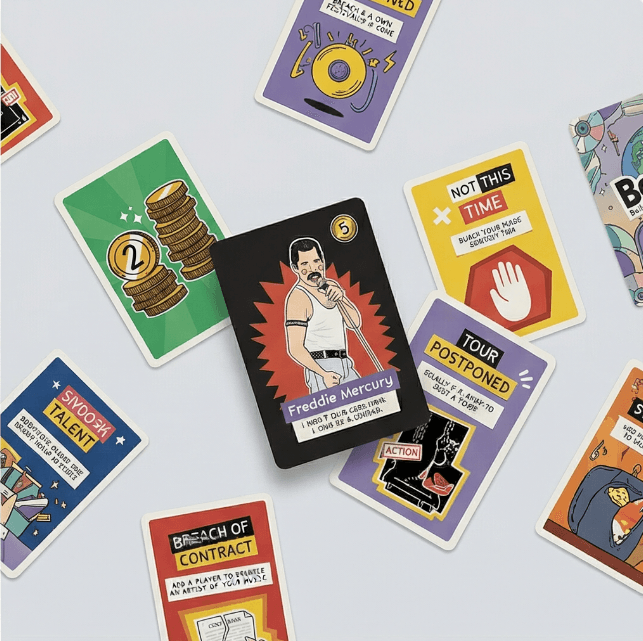
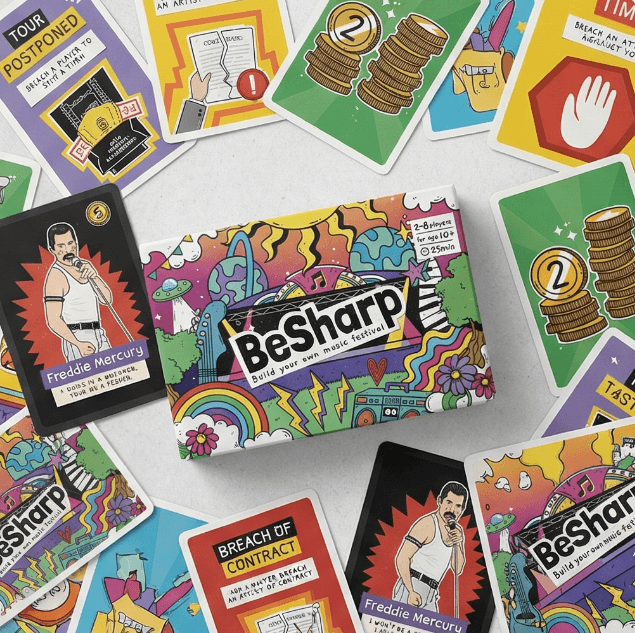
BeSharp is a competitive strategy card game where players act as festival producers, strategically contracting and sabotaging artists to build the ultimate music lineup. The game was born from the intersection of culture, systems thinking, and play.
Role
Co-founder
Game systems designer
Product strategist
Scope
Game mechanics
Visual direction
Playtesting & production
Collaboration
Illustration by Bianca Mol
Self-funded MVP
Framing the opportunity
In 2022, a conversation with friends about music, games, and festivals sparked a simple question: what if building a music festival lineup became a competitive strategy game?
Music festivals are not random collections of artists — they are curated systems driven by strategy, economics, timing, and negotiation. Behind every lineup is a producer making trade-offs: balancing genres, managing budgets, securing exclusivity, and reacting to competitors.
We saw an opportunity to transform that invisible strategic layer into a playable experience where players step into the role of producers, navigating scarcity, timing, and competition.
From idea to MVP: designing the system
We treated BeSharp less like a hobby and more like a startup:
- Defined a backlog and divided roles
- Set milestones and committed to a true MVP
- Kept the process playful while taking the craft seriously
The first version of BeSharp was entirely hand-drawn: paper cards, marker sketches, and printed text. Every playtest surfaced flaws in the system. We focused less on aesthetics and more on mechanics, constantly asking:
- Is the tension high enough?
- Do players feel real strategic agency?
- Is sabotage satisfying or just frustrating?
- Does randomness overpower skill?
We quickly realized the heart of the game wasn't the artists themselves — it was the contract system.
Designing competitive dynamics
Each player has a secret lineup goal. During the game, players contract artists to secure them for their festival. Contracts aren't permanent; other producers can disrupt agreements through strategic action cards.
The system had to balance three core elements:
- Scarcity — not all artists can belong to everyone.
- Risk — securing a strong artist should feel powerful but vulnerable.
- Strategy — players must read the table, anticipate moves, and adapt.
Because objectives are hidden, no one fully knows what lineup others are chasing. This secrecy introduces psychological strategy: players interpret behavior, decide when to protect themselves, and when to disrupt others.
In designing these mechanics, I applied the same thinking used in digital product ecosystems:
- How do incentives shape behavior?
- How does scarcity create urgency?
- How do we prevent runaway advantage?
- How do we balance fairness with excitement?
The result is a game that feels dynamic and social rather than deterministic. Victory isn't guaranteed by luck alone; it requires timing, awareness, and calculated risk.
Elevating the product: visual identity & collaboration
Once the mechanics felt solid, we faced a new challenge: perception. A game about music and festivals can't feel generic; it needs personality, energy, and visual charisma.
To elevate the product, we partnered with Bianca Mol, a Brazilian illustrator whose style brought vibrancy and character to the deck. We defined the visual tone as fun, energetic, modern, and expressive — capturing the spirit of live music culture.
We collaborated closely on character designs, color palettes, and card hierarchy. Every illustration needed to communicate value and personality while remaining legible during gameplay.
The transformation from paper prototype to illustrated deck marked a major shift: the product began to feel real — something that could live on a shelf, be picked up at a festival, or be backed on a crowdfunding platform.
My role & key learnings
In BeSharp, I acted as:
- Co-founder
- Game systems designer
- Product strategist
- Art director (with the illustrator)
- Production coordinator
Designing a competitive card game reinforced several principles that translate directly to digital product design:
- Incentives define behavior. When players "exploit" a mechanic, it's a signal that the system needs to adapt.
- Emotional tension drives engagement. The most memorable moments aren't just winning, but the last-minute reversals and contract breaks.
- Clarity is everything. In a physical game, confusion breaks immersion instantly — the same is true for complex digital products.
- Collaboration elevates products. Bringing in the right partners can transform an idea into a compelling, shippable experience.